


Gibeon Meteorite: History And Unique Patterns
Most people who pick up a Gibeon meteorite for the first time make the same mistake: they look for something alien about it. The weight surprises them first. Then they notice the surface: interlocking bands of silver and grey running in geometric diagonals across the polished face. That is usually when they stop talking.
No manufactured material produces that pattern. It cannot be milled, cast, or grown in a laboratory. It formed over millions of years inside the core of a planet that no longer exists, at a cooling rate so slow that a million years passed for every single degree of temperature drop. The pattern is called the Widmanstätten structure, and it is why Gibeon meteorites are collected, worn as jewellery, and studied by planetary scientists. Sometimes by the same person.
A planet that broke apart
Gibeon did not start as a meteorite. It started as the iron core of a small proto-planet, probably formed in the early solar system around 4 billion years ago. Something collided with that planet, a large enough impact to shatter it, and the fragments were scattered into space. What we pick up today in Namibia are pieces of that destroyed planetary core, still carrying the internal structure they developed when the planet was whole.
This matters for understanding the pattern. The Widmanstätten structure forms only inside a body large enough to develop a differentiated core, insulated from space by layers of rock that made cooling glacially slow. Smaller meteorites, which cooled faster, show no such structure. Gibeon’s parent body was big enough and old enough that the iron and nickel atoms had time to sort themselves into separate crystalline phases before the whole thing was destroyed.
The meteorite entered Earth’s atmosphere an estimated 30,000 years ago at roughly 27 kilometres per second, travelling at a low angle. It exploded high in the atmosphere rather than hitting the ground intact, which is why there is no impact crater. Pieces rained down across what is now southern Namibia over a strewn field stretching roughly 390 kilometres long and 120 kilometres wide. More than 21,400 kilograms of material have been recovered so far.
| Property | Detail |
|---|---|
| Classification | Group IVA fine octahedrite |
| Composition | About 91.8% iron, 7.7% nickel, plus cobalt, phosphorus, iridium, gallium and germanium |
| Estimated fall date | Around 30,000 years ago |
| Strewn field | Roughly 390 km long, 120 km wide, across southern Namibia |
| Material recovered | More than 21,400 kg to date |
| Legal status | Protected national monument in Namibia; export of new material is restricted |
The Nama people used it as iron ore
Before any European scientist classified Gibeon as a meteorite, the Nama people of the region had already figured out that the dense iron masses scattered across the Kalahari landscape were useful. They worked them into tool heads and assegai points. The material was better than anything they could smelt locally: pure iron-nickel alloy, no slag, no impurities, already solid.
In 1836, an English captain named J.E. Alexander heard reports of large iron masses near the Great Fish River and obtained samples. He sent them to London, where astronomer John Herschel confirmed they were extraterrestrial. That was the first time Gibeon’s nature was formally established, though the Nama had been using it for centuries before anyone in London knew it existed.
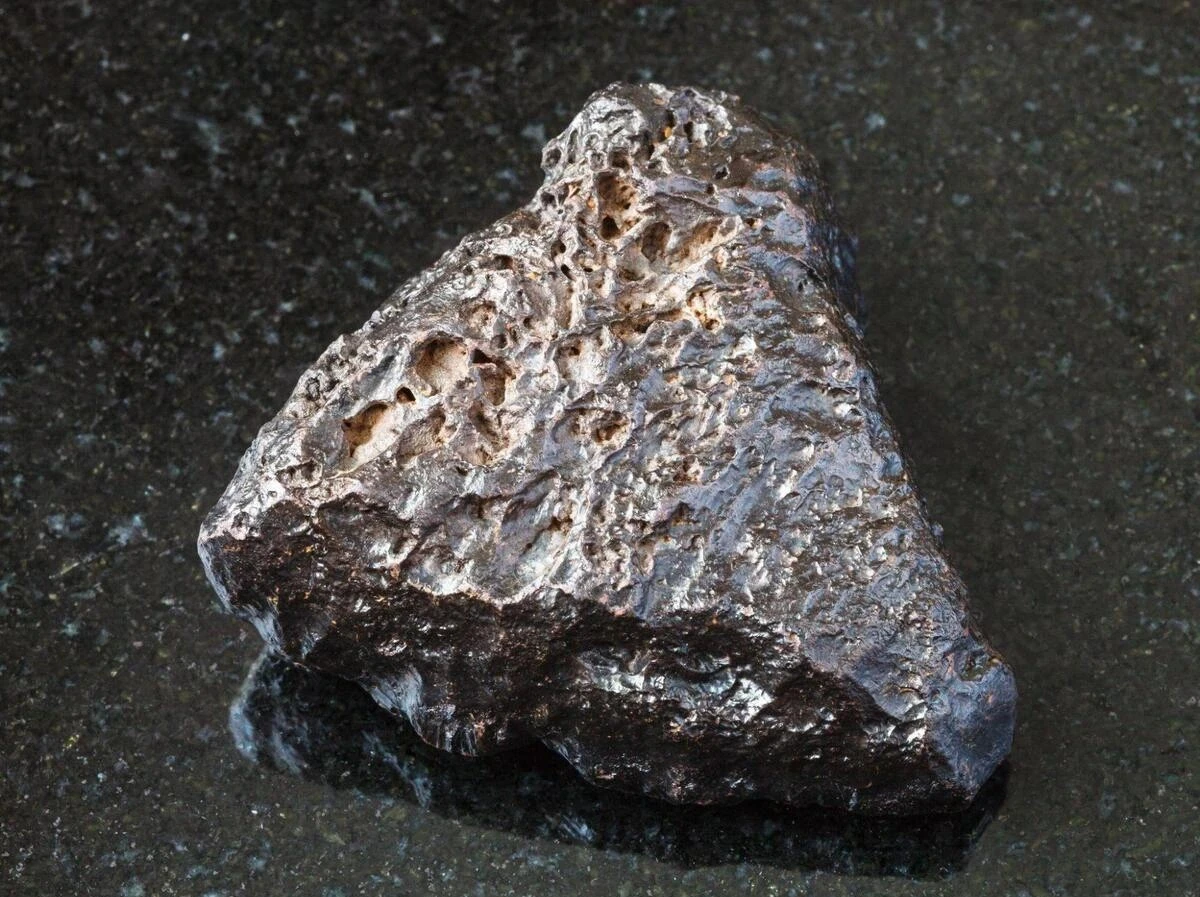
Between 1911 and 1913, 33 fragments were collected near the town of Gibeon and transported to the capital, Windhoek. The largest single mass recovered (650 kilograms) is now in the South African Museum in Cape Town. Namibia eventually declared Gibeon a protected national monument, making it illegal to remove material without authorisation. That legal protection, combined with the finite size of the strewn field, is a significant part of why authenticated Gibeon commands the prices it does.
What the Widmanstatten pattern actually is
Cut a Gibeon meteorite slice, polish the face, and treat it with dilute nitric acid. The acid attacks the 2 iron-nickel phases at different rates, leaving one phase slightly raised and the other slightly recessed. What emerges is the Widmanstatten structure: a mesh of intersecting bands, each band running parallel to one of the 4 sets of octahedral crystal planes that formed as the iron-nickel alloy solidified billions of years ago.
The two phases are called kamacite and taenite. Kamacite is low-nickel (around 6-7% nickel) and forms the lighter, wider bands. Taenite is high-nickel and fills the narrow borders between them, often with a characteristic bright rim visible under magnification. In Gibeon, which is classified as a fine octahedrite, the kamacite bands are narrow, typically 0.2 to 0.5 millimetres wide, which produces the tight, intricate geometry that makes Gibeon particularly prized over coarser octahedrites.
The orientation of the cut relative to the crystal planes changes what the pattern looks like. A cut parallel to one set of planes produces long parallel bands. A cut at a different angle reveals the triangular or hexagonal intersections. This means 2 slices from the same Gibeon mass, cut at slightly different angles, will show patterns that look visually distinct from each other. Every piece is genuinely unique because the geometry of each face depends on where exactly the blade entered the crystal structure.
This is not a feature that photographs reproduce well. The pattern has a three-dimensional quality: the slight difference in level between the 2 phases catches light differently as the angle changes. Seeing a Gibeon slice in person under good light is a different experience from looking at images of one.
Caring for Gibeon in Singapore’s climate
Iron rusts. That is the central maintenance fact for any Gibeon owner, and Singapore’s humidity makes it more pressing than it would be in a temperate country.
Uncoated polished Gibeon will begin to show surface oxidation within days to weeks in high-humidity conditions. The rust appears first along cut edges, then spreads across the polished face as a reddish-brown film. It does not destroy the piece (the pattern survives underneath), but it obscures it. Most collectors coat polished faces with a thin layer of Renaissance wax or a microcrystalline wax after polishing. Reapply every few months, more frequently if the piece is handled regularly.
Storage matters as much as coating. A sealed display case with silica gel desiccant keeps ambient humidity low around the specimen. Do not store Gibeon in open display in an air-conditioned room that also gets humid when the air conditioning is off; the temperature cycling drives condensation. Jewellery pieces worn daily will patina from skin contact and ambient moisture; most wearers accept this as part of the material’s character and address it periodically with a light clean and re-wax.
If rust does appear, it can be removed from an uncoated piece with 0000-grade steel wool, and then the surface can be re-polished and protected. Do not use water-based cleaners on Gibeon at any point.
What to check when buying
Gibeon cannot be faked in the way that moldavite or amber sometimes is, because the Widmanstatten pattern requires millions of years and a specific cooling environment to form. No terrestrial iron alloy will show it after etching. A few checks still matter:
- Pattern continuity. The bands should run unbroken across the face. Spotty or interrupted banding usually means a poor etch, which can be redone, or a piece with inclusions that disrupted crystal growth.
- Weight. Gibeon runs about 7.8 grams per cubic centimetre, roughly 3 times denser than granite. A palm-sized slice should feel noticeably heavy.
- Provenance. Worth having, but the pattern itself is the real authentication; the paperwork is just the record.
East Ocean sources Gibeon specimens through established meteorite dealers and can walk you through the specific characteristics of individual pieces at our Genting Lane showroom.